Elizabeth Colborne
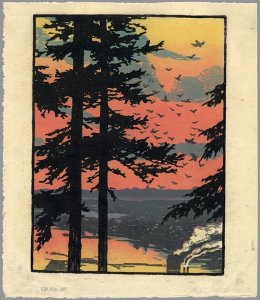
Elizabeth Colborne was one of the most interesting, original, and accomplished artists active in Washington State during the first half of the 20th century and is most remembered for her extraordinary color woodcuts. She was the foremost regional practitioner of the medium and produced some of the most unique prints associated with the American Arts and Crafts movement. Her mastery of the Japanese technique of multi-block printing, combined with innovations such as inking the verso of the print, enabled her to produce vivid and painterly effects and appears to be the most advanced of that produced by all her contemporaries.
Despite the fact that an impressive body of her work exists today, her personal life and history have eluded us. She left almost no records and biographical material is scarce. Luckily, a journal that Colborne kept during the summer of 1933 has survived which reveals a glimpse of her personality through her entries.
Family Life
Elizabeth Aline Colborne was born on February 15, 1885 in Chamberlain, South Dakota. She was the second daughter of Birney Barnes Colborne (1851-1893), a very successful civil engineer and native of Kent, England and Ella Bowen Colborne (1849-1892) of Wisconsin.
Elizabeth or "Bessie" as her family knew her, was likely fascinated by her father's detailed mechanical drawings, and he encouraged his young daughter by teaching her to draw. After the death of his wife in 1892, the newly single father, Mr. Colborne died the following year from pneumonia at the age of forty-two leaving behind Elizabeth and her two sisters, Belle Evelyn born in 1883 and Bernice born in 1887. Being too young to care for themselves, the Colborne sisters went to live with relatives and at the age of twelve, Elizabeth relocated to the Northwest under the care of a maternal aunt and uncle, Martha and Thomas Kershaw of Bellingham, Washington.
After graduating from Bellingham High School, Elizabeth went to New York to attend the Pratt Institute in Brooklyn, beginning in 1903. Returning to Bellingham in 1905, she began a successful commercial career that would soon have her residing part of the year there and part in the Pacific Northwest until the early 1930's. Colborne never married or had any children. She died on February 21, 1948 at her home in Seattle where she had lived for the last ten years of her life.
Early Career and Commercial Success
After graduating from Pratt, Colborne returned to Bellingham in July, 1905 to pursue a career as an illustrator while also setting up a studio to teach young children. Some of her earliest known commercial work appeared in the June, 1906 issue of Westerner magazine (later Sunset magazine). Around 1907, Colborne obtained a position with the Decorative Designers of New York City, doing cover designs, end papers, and decorative pages for books. She soon began her lifelong habit of spending part of the year in New York City and usually summer, in the Northwest.
Colborne decided to expand on her art studies and enrolled at the National Academy of Design in New York in 1910. Over the next three years, she studied etching with noted printmaker Charles F. Mielatz (1864-1919). During this time, she also studied with Robert Henri (1865-1929) and with artist/illustrator Rockwell Kent (1882-1971) at Monhegan Island, Maine. Unfortunately, none of Colborne's etchings have surfaced and we have no record or reproductions to assess her accomplishments in intaglio printmaking.
Colborne's work with the Decorative Designers of New York allowed her to build up a reputation as a first- rate designer and illustrator of children's books. In addition to illustrating the work of various authors, she wrote and illustrated several of her own publications. Eventually her design work would be sought after by several important companies including Platt & Monk, a prominent publisher of children's books. She conceived and illustrated several books for children that encouraged creativity through bold and whimsical design. These were published by Reilly & Britton, publishers of works by Hans Christian Andersen and the extremely successful "Oz" series by L. Frank Baum.
To augment her income, she designed bookplates and produced numerous cliché verre prints which she called "sun etchings". She would use this process over the next few decades to produce beautiful, intimate Christmas Cards and personalized notes for a national audience.
Exhibitions and Later Career
Colborne concentrated on commercial work during the teens and twenties but she also exhibited a few times in venues such as New York's MacDowell Club. In 1924, Colborne expanded on her art education and studied woodblock printmaking at the Art Students League with Allen Lewis (1873-1957). It is likely that following this class, Colborne produced her large scale color woodcuts over the next decade.
Colborne continued to divide her time between New York and Washington State during the 1920's but when the stock market crashed in 1929 followed by the severe economic depression, her production began to wane. She returned to Bellingham and spent the summer of 1933 living in a cabin with the purpose of creating art. During that time, she kept a detailed journal that gives an intimate account of her working methods and personality.
At the end of Colborne's summer of 1933 she participated in President Roosevelt's Public Works of Art Program (the pre-curser to the WPA was administered by the Federal Civil Works Administration under Roosevelt's "New Deal" which existed from December 1933 to June 1934). After the demise of the programs, most of the art was dispersed to public institutions, sold, or lost to time. Colborne's prints managed to find their way into a few regional collections such as the Longview, Washington Public Library and the Seattle Public Library.
In 1939, she was accepted as a member of the prestigious National Association of Women Artists based in New York City and shortly after held an exhibition of her work at the Argent Gallery. Her color woodcuts were also represented by The Morton Galleries at 130 West 57th St. and the Grant Galleries which also sponsored several exhibitions of the Women Painters of Washington during the 1930's. In November of that same year she was given her third solo exhibition at the Studio Museum of the Western Washington College of Education (now Western Washington University). The first two were held in 1934 and 1936. The following year, the Seattle Art Museum presented "Drawings and Prints by Elizabeth Colborne" which ran from February 7 through March 3, 1940.
By 1942, Colborne, now fifty-seven years of age, was hired by the Boeing Company as a tracer. Within a year she became a draftsperson and technical illustrator. Colborne continued to work for Boeing until she retired in February,1948.
The Elizabeth Colborne Collection
Whatcom Museum has the most comprehensive collection of Elizabeth Colborne's works with over 250 original paintings, block prints, drawings and illustrations. In addition, we hold a number of related ephemeral materials such as a sketchbook, pages from her journal, letters and poems, wood blocks used in her printing process and copies of books which she illustrated. With the majority of our collection gathered in the 1960's and 70's through both institutional and private donations, we are dedicated to preserving her legacy through continued acquisitions, institutional loans and publications of her works.
Excerpts from catalogue for Evergreen Muse: The Art of Elizabeth Colborne, 2011, written by David Martin of Seattle, Washington.